
Keto Diet vs Low-Fat Diet vs Balanced Portion-Control Diet: Which Is Best for Weight Loss?
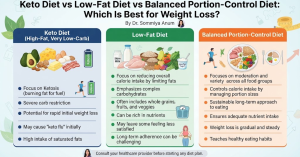
By Dr. Sommiya AnumKeto vs Low-Fat vs Balanced
Introduction
When it comes to weight loss, there is no shortage of diets promising fast results. Keto, low-fat, intermittent fasting, high-protein and portion-control diets have all become popular. But which approach is actually best?
The answer is not simply the diet that causes the fastest initial drop on the weighing scale.
A successful weight-loss diet should help reduce excess calorie intake, provide adequate nutrition, support muscle preservation and, most importantly, be realistic enough to follow for months and years.Keto vs Low-Fat vs Balanced Portion-Control Diet
This is especially relevant for South Asian and Indo-Pakistani communities, where traditional meals may include roti, naan, rice, paratha, potatoes, lentils, curries, dairy products, sweets and fried foods.
Let’s compare keto vs low-fat vs balanced portion-control diets and understand which approach may be more practical for sustainable weight management.
1. What Is a Keto Diet?
The ketogenic, or keto diet, is a very-low-carbohydrate, relatively high-fat dietary pattern. Carbohydrates are significantly restricted, while fat provides a larger proportion of daily energy.
Keto Diet vs Low-Fat Diet vs Balanced Portion-Control Diet
Typical keto foods include:
- Eggs
- Chicken and meat
- Fish
- Cheese and selected dairy products
- Nuts and seeds
- Avocado
- Olive oil
- Non-starchy vegetables
Foods commonly restricted include:
- Sugar and sweets
- Soft drinks
- Bread
- Naan
- Roti
- Rice
- Pasta
- Potatoes
- Many grain-based foods keto-diet-vs-low-fat-diet-vs-balanced-portion-control-diet
How Does Keto Work?
When carbohydrate intake becomes very low, the body’s glycogen stores decrease. The liver then produces ketone bodies, which can be used as an energy source.
Keto may produce relatively rapid initial weight loss. However, some of the early decrease on the scale can be water associated with reduced glycogen stores rather than body fat alone.
Potential Benefits of Keto
A well-planned keto diet may:
- Promote short-term weight loss
- Reduce appetite in some people
- Improve blood-glucose control in certain individuals
- Reduce reliance on highly refined carbohydrates
- Be useful for specific medical indications under professional supervision
Potential Disadvantages
Keto can also be challenging because it is highly restrictive. Some people may experience constipation or difficulty meeting their fiber and micronutrient needs if the diet is poorly planned.
Keto Diet vs Low-Fat Diet vs Balanced Portion-Control Diet
It may also be difficult to follow during family meals, weddings, restaurants and social events—particularly in cultures where rice, roti, naan and desserts are important parts of meals.
Keto is not automatically superior simply because it can produce rapid initial weight loss.
2. What Is a Low-Fat Diet?
A low-fat diet reduces dietary fat, particularly foods high in saturated and trans fats, while emphasizing vegetables, fruits, whole grains and lean protein.
Common foods may include:
- Vegetables
- Fruits
- Whole grains
- Beans and lentils
- Lean chicken
- Fish
- Low-fat dairy
- Moderate amounts of healthy oils and nuts
Traditional low-fat approaches may reduce:
- Deep-fried foods
- Large amounts of butter
- Excess ghee
- Cream
- High-fat meats
- Fried snacks
- Pastries and commercially baked foods
Potential Benefits
A well-designed low-fat eating pattern can help:
- Reduce calorie intake
- Increase consumption of vegetables and fruits
- Provide dietary fiber
- Support cardiovascular health when focused on minimally processed foods
- Fit relatively easily into many traditional meals
However, low-fat does not automatically mean low-calorie. Large portions of rice, roti, sweets or refined carbohydrates can still contribute to excess calorie intake.
3. What Is a Balanced Portion-Control Diet?
A balanced portion-control diet focuses less on completely eliminating a food group and more on managing portions, food quality and overall calorie intake.
A balanced plate might contain:
- A substantial portion of vegetables
- A source of protein
- A moderate portion of whole grains or another carbohydrate
- A smaller amount of healthy fat
- Fruit or dairy according to individual needs
For an Indo-Pakistani household, this approach may mean eating a smaller portion of rice or roti while increasing vegetables and protein rather than eliminating traditional foods completely.
For example, instead of having several rotis with a calorie-dense curry, a person might choose:
1 moderate roti + chicken/daal + a large serving of vegetables or salad + yogurt
The exact portion should be individualized according to age, body size, activity level, medical conditions and weight-loss goals.
Why Portion Control Can Be Sustainable
The biggest advantage is flexibility.
You do not necessarily need to eliminate:
- Roti
- Rice
- Daal
- Fruit
- Dairy
- Occasional desserts
Instead, you learn how to include them in appropriate amounts.
This can make a diet easier to maintain within family meals and social situations.
4. Keto vs Low-Fat vs Portion Control: Which Is Better?
There is no universally best diet for everyone.
| Diet | Main Strategy | Potential Advantage | Common Challenge |
|---|---|---|---|
| Keto | Very low carbohydrate | May reduce appetite and produce rapid initial weight loss | Highly restrictive |
| Low-Fat | Reduce dietary fat | Can encourage vegetables, fruits and whole grains | Low-fat foods can still be calorie-dense in large portions |
| Balanced Portion Control | Manage portions and food quality | Flexible and culturally adaptable | Requires consistent portion awareness |
For long-term weight management, the best diet is often the one that a person can follow consistently while maintaining adequate nutrition.
5. What About Belly Fat
One of the most common questions is:
“Which diet burns belly fat fastest?”
Unfortunately, no particular diet can guarantee targeted fat loss from the abdomen.
When body fat decreases, the amount lost from different areas depends partly on genetics, sex, age, hormones and overall body-fat distribution.
Reducing total body fat through an appropriate calorie deficit can eventually reduce abdominal fat.
For many people, combining dietary changes with regular physical activity, resistance training, adequate sleep and stress management is more useful than searching for a specific “belly-fat-burning” food.
6. Central Obesity vs Overall Obesity
Central obesity refers to excess fat accumulation around the abdomen. It is particularly important because abdominal or visceral fat is associated with increased metabolic and cardiovascular risk.
Overall obesity is commonly assessed using measures such as body mass index (BMI), while central obesity can be evaluated using waist circumference and other clinical measurements.
A person can therefore have a relatively moderate body weight but still carry excess abdominal fat.
This is one reason why monitoring waist circumference alongside body weight can provide useful information.
7. Apple Shape vs Pear Shape
People often describe body shapes as apple-shaped or pear-shaped.
An apple-shaped pattern generally means more fat is carried around the abdomen and upper body. A pear-shaped pattern describes greater fat accumulation around the hips and thighs.
These descriptions are useful for understanding body-fat distribution, but they are not medical diagnoses.
Abdominal fat tends to be more strongly associated with metabolic health risks than fat stored predominantly around the hips and thighs.
However, body shape cannot be changed through a diet that selectively burns fat from one area. Overall fat loss and healthy lifestyle habits remain the main strategies
8. Eastern vs Western vs Mediterranean Eating Patterns
Diet quality is influenced not only by calories but also by cultural food patterns.
Eastern/South Asian Diets
Traditional South Asian diets can provide valuable foods such as:
- Lentils
- Chickpeas
- Beans
- Vegetables
- Yogurt
- Spices
- Whole grains
The challenge often comes from excessive portions, fried preparation methods, sugary drinks, sweets and frequent use of calorie-dense fats.
A healthier approach does not necessarily require abandoning traditional foods. Cooking methods and portion sizes can be modified.
Western Dietary Patterns
Western diets vary considerably, but highly processed foods, sugary drinks, refined grains and large portions can make calorie control difficult.
A healthier Western-style pattern can still include vegetables, fruits, whole grains, lean proteins and minimally processed foods.
Mediterranean Diet
The Mediterranean dietary pattern emphasizes vegetables, fruits, legumes, whole grains, nuts, fish, olive oil and other minimally processed foods.
It is often considered a heart-healthy dietary pattern and can be adapted to South Asian cooking.
For example, olive oil, vegetables, lentils, grilled fish and beans can fit naturally into many cuisines.
9. So, Which Diet Is Best for Weight Loss?
For many people, a balanced portion-control approach may be the most practical starting point because it combines calorie awareness with flexibility.
However, individual needs matter.
Someone may prefer a lower-carbohydrate approach because it helps control appetite. Another person may find a lower-fat pattern easier to maintain. Someone else may succeed with a Mediterranean-style or culturally adapted balanced diet.
The key questions are:
- Can you follow the diet consistently?
- Does it provide adequate protein, fiber, vitamins and minerals?
- Does it create an appropriate calorie deficit?
- Does it support healthy eating habits?
- Can you maintain it after reaching your goal weight?
A diet that produces impressive results for four weeks but cannot be maintained for six months may be less useful than a moderate approach that becomes part of your lifestyle.
10. Practical Weight-Loss Strategy for Indo-Pakistani Meals
You do not necessarily need to completely remove traditional foods.
Try practical changes such as:
- Choose roti portions carefully instead of eating several automatically.
- Keep rice portions moderate.
- Increase vegetables and salad.
- Include a protein source such as eggs, chicken, fish, lentils or beans.
- Limit deep-fried foods.
- Reduce sugary drinks.
- Keep sweets for occasional portions rather than daily habits.
- Choose grilled, baked, steamed or lightly cooked foods more often.
- Pay attention to cooking oil, ghee and butter because small amounts can add substantial calories.
- Eat slowly and recognize hunger and fullness signals.
The goal is not to make traditional food “bad.” The goal is to create a healthier relationship with portion size, food quality and consistency.
11. The Role of Exercise and Lifestyle
Diet is only one part of healthy weight management.
Regular physical activity can help support:
- Fat loss
- Muscle preservation
- Cardiovascular health
- Insulin sensitivity
- Mood
- Sleep
- Long-term weight maintenance
Resistance training can be particularly useful during weight loss because preserving muscle helps maintain functional strength and a healthier body composition.
Sleep and stress management also deserve attention. Poor sleep and chronic stress can make appetite regulation and healthy eating more difficult for some people.
Final Verdict
So, keto vs low-fat vs balanced portion-control diet—which is best for weight loss?
There is no single winner for every person.
Keto may be effective for some individuals but is restrictive and may be difficult to sustain.
Low-fat diets can be nutritious and effective when they emphasize whole foods and appropriate portions.
Balanced portion control offers flexibility and may be particularly practical for people who want to continue enjoying culturally familiar foods such as roti, rice, daal and vegetables.
Ultimately, sustainable weight loss depends less on finding a “perfect” diet and more on creating healthy eating habits that you can maintain consistently.
If you have obesity, diabetes, kidney disease, liver disease, are pregnant or breastfeeding, or take medications that can affect blood glucose or weight, seek individualized advice from a qualified healthcare professional before making major dietary changes.
- I.V Slimming Shots
Anchor text: I.V slimming shots for weight management - Skin Glow / Beauty IV Therapy
Anchor text: beauty IV therapy and wellness support - I.V Anti-Aging Collagen Shothttps://www.cdc.gov/healthy-weight-growth/s
Anchor text: I.V. collagen shots - I.V. Glutathione Shots
Anchor text: I.V. glutathione shots - Harvard T.H. Chan School of Public Health – The Nutrition Source — for evidence-based nutrition and healthy eating information.
- CDC – Healthy Weight, Nutrition, and Physical Activity — for healthy weight-management guidance.
- NIDDK – Body Weight Planner / Weight Management — for evidence-based weight-loss information.
Remember: the best weight-loss diet is not necessarily the most restrictive one—it is the one that is nutritionally adequate, realistic, sustainable and appropriate for your individual health needs.Keto vs Low-Fat vs Balanced Portion-Control Diet