
Is PLLA Better Than Dermal Filler? A Complete Guide to Poly-L-Lactic Acid Treatment in Lahore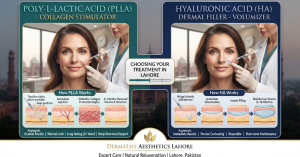
PLLA treatment in Lahore is becoming increasingly popular among people who want gradual, natural-looking facial rejuvenation without an overfilled appearance. But one question comes up frequently:
Is PLLA better than dermal filler?
The short answer is: not necessarily. PLLA and dermal fillers are designed to address different aesthetic concerns. In some patients, PLLA may be a better choice for gradual collagen stimulation and overall facial rejuvenation, while dermal fillers may be more appropriate when precise, immediate volume or contour correction is required.
The best treatment is therefore not determined by which product is universally “better.” It depends on your facial anatomy, skin quality, degree of collagen loss, volume loss, ageing pattern, treatment goals and medical assessment.
PLLA, or Poly-L-Lactic Acid, is primarily considered a collagen biostimulator. Instead of simply placing volume beneath the skin, PLLA is designed to stimulate collagen production over time. Clinical literature supports its potential to improve facial volume, skin quality and elasticity, although the quality of evidence varies and individual results differ. (PubMed)
For anyone considering PLLA Poly-L-Lactic Acid treatment in Lahore, understanding the difference between a collagen biostimulator and a conventional dermal filler is essential before choosing a treatment.
What Is PLLA?
Poly-L-Lactic Acid (PLLA) is a biodegradable synthetic polymer used in aesthetic medicine as a collagen-stimulating injectable.
Unlike a traditional filler that is primarily placed to create immediate structural volume, PLLA works gradually. The intended aesthetic effect develops as the body’s collagen-remodelling response occurs.
This is why PLLA is commonly described as a collagen biostimulator rather than simply a conventional dermal filler.
Research and expert recommendations describe PLLA as an option for facial rejuvenation where gradual improvement in volume, skin quality and collagen-related changes is desired. (PubMed)
How Does PLLA Work?
The treatment process can be understood in three broad stages:
1. Treatment planning
A qualified medical professional evaluates facial anatomy, skin quality, tissue changes, volume loss and aesthetic goals.
2. Collagen stimulation
PLLA particles are placed in carefully selected tissue planes. The material acts as a biostimulatory stimulus rather than functioning only as an immediate volume replacement.
3. Gradual facial rejuvenation
Over time, collagen production and tissue remodelling can contribute to improvement in facial fullness, skin quality and overall appearance.
The results are therefore usually progressive rather than an instant transformation.
What Are Dermal Fillers
Dermal fillers are injectable products used to restore or create volume, improve contours and soften certain facial lines or depressions.
There are different filler materials, with hyaluronic acid (HA) being one of the most widely used.
Depending on the product and treatment area, dermal fillers may be used for:
- Lip enhancement
- Cheek augmentation
- Chin projection
- Jawline contouring
- Nasolabial folds
- Facial volume restoration
- Certain areas of structural correction
Is PLLA Better Than Dermal Filler
Some dermal fillers may also have secondary biostimulatory effects, so the distinction is not completely absolute. However, conventional HA fillers are generally used primarily for volume replacement and contouring, whereas PLLA is specifically valued for its collagen-stimulating approach. (PubMed)
PLLA vs Dermal Filler: What Is the Difference?
The simplest way to understand the difference is:
| Feature | PLLA | Dermal Filler |
|---|---|---|
| Main purpose | Collagen stimulation | Volume/contour correction |
| Onset | Gradual | Often immediate |
| Approach | Biostimulation | Structural augmentation |
| Best suited for | Diffuse collagen loss and gradual rejuvenation | Specific volume or contour concerns |
| Appearance | Progressive, natural-looking change | Immediate correction depending on product |
| Treatment planning | Highly individualized | Highly individualized |
| Results | Develop over time | Often visible immediately |
| Can they be combined? | Sometimes | Sometimes |
This does not mean PLLA is automatically better.
It means the two treatments solve different problems.
Is PLLA Better Than Dermal Filler?
The Answer Depends on What You Want to Improve
If your primary concern is:
“I want my cheeks to look more defined immediately.”
A suitable dermal filler may be more appropriate.
If your concern is:
“My face looks thinner, my skin feels less firm and I want gradual overall rejuvenation.”
PLLA may be considered.
If you have both volume loss and collagen loss, a qualified aesthetic physician may determine that a combination or staged treatment approach is more suitable.
The decision should never be based simply on social-media trends, the number of syringes someone else received or the cheapest treatment package available.
When PLLA May Be a Better Choice
PLLA may be particularly attractive for patients seeking gradual facial rejuvenation rather than immediate volumization.
1. You Want a Natural-Looking Change
Some people are concerned that traditional fillers could make their face appear overly full.
Properly planned PLLA treatment aims for gradual changes rather than an instant increase in volume.
2. You Have Generalized Facial Volume Loss
Ageing can involve changes across multiple facial compartments rather than a single isolated wrinkle.
PLLA may be considered when the treatment objective involves broader facial rejuvenation and collagen remodelling.
3. You Want Collagen Stimulation
One of the main reasons people consider PLLA collagen stimulator treatment is its ability to stimulate a biological collagen response.
Systematic reviews have reported improvements in parameters such as facial volume, elasticity and wrinkle appearance, although researchers also note limitations in the quality and consistency of available evidence. (PubMed)
4. You Prefer Gradual Results
PLLA is not designed around the concept of changing the face overnight.
For patients who prefer progressive improvement, this can be an attractive characteristic.
When Dermal Filler May Be Better
Dermal fillers can be preferable when a patient needs precise, targeted volume correction.
For example, a patient may want:
Is PLLA Better Than Dermal Filler
- More defined lips
- Chin projection
- Cheek contour
- Jawline enhancement
- Correction of a localized depression
- Immediate volume restoration
In such cases, a filler can provide a degree of immediate structural correction that a collagen biostimulator may not provide in the same way.
PLLA Does Not Replace Every Type of Dermal Filler
This is an important distinction.
A patient looking for lip augmentation, for example, may need a treatment designed specifically for controlled lip volume and contour.
A patient experiencing diffuse facial collagen loss may have a different treatment requirement.
Therefore, asking:
“Is PLLA better than filler?”
is less useful than asking:
“Which treatment is appropriate for my facial anatomy and treatment goal?”
That is the more medically meaningful question.
PLLA Facial Rejuvenation: Who May Be a Candidate?
There is no single age at which every person should start PLLA.
Patient selection should consider:
-
- Facial anatomy
- Degree of collagen loss
- Skin quality
- Volume changes
- Skin laxity
PLLA treatment Lahore
Is PLLA better than dermal filler
Poly-L-Lactic Acid Lahore
PLLA collagen stimulator
PLLA facial rejuvenation
PLLA treatment cost Lahore
collagen biostimulator Lahore
Poly-L-Lactic Acid treatment
PLLA injections Lahore
PLLA vs dermal filler
PLLA filler alternative
facial rejuvenation Lahore
- Previous aesthetic treatments
- Medical history
- Treatment expectations
- Desired outcome
Expert recommendations emphasize careful patient selection, treatment planning, appropriate technique and aftercare when using injectable PLLA. (PubMed)
Can Younger Patients Have PLLA?
Potentially, yes—but age alone should not determine treatment.
A younger patient with a specific aesthetic concern may require a completely different approach from an older patient with substantial collagen and volume loss.
The appropriate question is not:
“Am I old enough for PLLA?”
It is:
“Do I have a clinically appropriate indication for collagen biostimulation?”
That decision should be made during an individualized consultation.
PLLA in Your 30s: Is It Too Early?
People in their 30s may begin noticing subtle changes in:
- Skin firmness
- Facial volume
- Fine lines
- Cheek fullness
- Skin elasticity
- Overall facial freshness
However, this does not automatically mean PLLA is necessary.
Preventive or early aesthetic treatment should be conservative and based on an individual’s anatomy and goals.
A qualified dermatologist should determine whether collagen stimulation is appropriate or whether simpler skincare, energy-based treatments, lifestyle measures or another aesthetic procedure would make more sense.
PLLA for More Advanced Facial Ageing
For patients with more noticeable age-related changes, treatment planning may involve several concerns simultaneously.
These can include:
- Loss of facial volume
- Reduced skin elasticity
- Skin laxity
- Fine lines
- Changes in facial proportions
- Loss of youthful contours
PLLA may form part of a broader facial rejuvenation strategy, but it should not be viewed as a universal solution for every ageing concern.
Does PLLA Give Immediate Results?
Generally, PLLA is associated with gradual improvement rather than relying on immediate final correction.
Immediately after an injectable treatment, temporary swelling or other effects can make the face appear different. These early changes should not be confused with the final collagen-related result.
The intended aesthetic improvement develops progressively.
This is one reason patients need realistic expectations.
How Long Does PLLA Last?
Longevity varies according to:
- The specific product
- Patient characteristics
- Treatment plan
- Degree of collagen loss
- Treatment technique
- Individual biological response
Published studies and reviews have reported effects extending for many months, with some studies reporting outcomes sustained to approximately 25 months. However, this should not be interpreted as a guarantee that every patient will experience the same duration. (PubMed)
A consultation should focus on your expected treatment course rather than promising a fixed number of months.
How Many PLLA Sessions Are Needed?
There is no universal number of sessions.
Your treatment plan may depend on:
- Age
- Facial volume loss
- Skin quality
- Collagen loss
- Treatment area
- Desired outcome
- Previous aesthetic procedures
- Individual response
Some patients may require a staged treatment plan rather than attempting to achieve everything during one appointment.
The goal should be appropriate correction—not maximum product use.
Is PLLA Painful?
Injectable treatments can cause discomfort.
Depending on the treatment approach, comfort measures may include:
- Topical anaesthesia
- Local anaesthesia
- Lidocaine-containing preparation where appropriate
- Cooling measures
- Appropriate injection technique
Temporary tenderness, swelling or bruising can occur after injectable treatments.
Your medical professional should explain expected side effects and aftercare before treatment.
What Are the Possible Risks of PLLA?
PLLA is a medical injectable procedure and should not be treated as a simple beauty service.
Possible adverse effects can include:
- Pain
- Tenderness
- Swelling
- Bruising
- Redness
- Injection-site reactions
- Palpable or visible nodules
- Lumps
- Unevenness
- Inflammatory reactions
- Infection
- Other complications related to injection technique
The evidence base supports potential effectiveness, but systematic reviews also emphasize that further high-quality research is needed. (PubMed)
Correct patient selection, product handling, injection technique and follow-up are important parts of safe aesthetic practice.
Why Choosing a Qualified Medical Professional Matters
Facial rejuvenation is not simply about injecting a product.
It requires knowledge of:
Facial Anatomy
The face contains important blood vessels, nerves, muscles, fat compartments and connective tissue structures.
Ageing Patterns
Two people of the same age can have completely different patterns of facial ageing.
Tissue Planes
Injectable products must be placed appropriately according to the treatment plan and product characteristics.
Product Characteristics
PLLA is different from HA filler, CaHA and other injectable products.
Aesthetic Proportion
The objective should be harmony and balance rather than simply adding volume.
Patient Safety
Medical history, contraindications, previous procedures and expectations all need to be considered.
Expert consensus literature specifically emphasizes patient selection, preparation, injection technique and management of adverse effects in PLLA treatment. (PubMed)
PLLA vs Filler: Which Gives a More Natural Look?
Neither treatment automatically produces a natural or unnatural result.
Technique and treatment planning matter enormously.
A carefully planned filler treatment can look extremely natural.
A poorly planned treatment can look excessive.
Similarly, PLLA can provide subtle gradual rejuvenation when appropriately selected and administered, but it is not automatically risk-free or guaranteed to look natural.
The goal should always be:
The right product + the right patient + the right indication + the right technique.
Can PLLA and Dermal Fillers Be Combined?
In selected patients, different aesthetic treatments may be combined or staged.
The reason is simple:
PLLA and dermal fillers can address different aspects of facial ageing.
For example:
- PLLA may address broader collagen-related rejuvenation.
- HA filler may address a specific area requiring structural volume.
- Other treatments may target pigmentation, skin texture or laxity.
Combination treatment should be individualized rather than automatically recommended.
A qualified medical professional should determine whether combining procedures is appropriate for your anatomy, medical history and treatment objectives.
How Much Does PLLA Cost in Lahore?
The PLLA treatment cost in Lahore can vary considerably.
There is no responsible single price that applies to every patient because treatment requirements differ.
Factors affecting cost can include:
- Product used
- Product authenticity
- Amount required
- Number of treatment sessions
- Treatment areas
- Clinical expertise
- Consultation and follow-up
- Complexity of facial rejuvenation
- Individualized treatment plan
A very low price should not automatically be interpreted as a bargain.
Before choosing a clinic, patients should ask about the product being used, its authenticity, the professional performing the treatment and the treatment plan.
Why the Cheapest PLLA Treatment May Not Be the Best Choice
Aesthetic medicine is not simply a product-price comparison.
You are also paying for:
Assessment + medical expertise + treatment planning + product quality + technique + safety + follow-up.
If two clinics quote dramatically different prices, ask why.
Important questions include:
- What exact product is being used?
- Is the product authentic and appropriately sourced?
- Who will perform the procedure?
- What are the professional’s qualifications?
- How many sessions are recommended and why?
- What complications should I know about?
- What aftercare is provided?
- What happens if I develop a complication?
These questions are more valuable than choosing a treatment based only on price.
Your Face Deserves a Personalized PLLA Plan
PLLA treatment should never be based on:
“How many syringes did she get?”
or:
“How cheap can I get the treatment?”
Instead, ask:
“What does my face actually need?”
Your facial structure, skin quality, ageing pattern and goals are unique.
A good aesthetic treatment plan should respect those differences.
PLLA vs Dermal Filler: A Simple Decision Guide
Choose PLLA when the primary goal may be:
- Gradual collagen stimulation
- Overall facial rejuvenation
- Progressive improvement
- Addressing broader age-related changes
- Avoiding an immediately overfilled appearance
Consider dermal filler when the primary goal may be:
- Immediate volume
- Precise contouring
- Lip enhancement
- Chin projection
- Cheek definition
- Localized volume restoration
Consider individualized combination treatment when:
- You have both collagen loss and specific volume deficits
- Multiple facial ageing concerns coexist
- A physician determines that different modalities can complement one another
Frequently Asked Questions About PLLA
What is PLLA?
PLLA stands for Poly-L-Lactic Acid. In aesthetic medicine, injectable PLLA is used primarily as a collagen biostimulator to support gradual facial rejuvenation.
Is PLLA the same as dermal filler?
No. PLLA is primarily used for collagen stimulation, while conventional dermal fillers are generally used to provide immediate or targeted volume and contour correction. Some fillers may also have biostimulatory effects. (PubMed)
Is PLLA better than dermal filler?
Neither is universally better. PLLA may be more suitable for gradual collagen stimulation, while dermal filler may be more appropriate for immediate, targeted volume or contour correction.
What age is best for PLLA?
There is no universal “best age.” Suitability depends on facial anatomy, skin quality, collagen loss, volume changes, medical history and treatment goals.
How many PLLA sessions are needed?
The number of sessions varies by patient and treatment plan. A medical assessment should determine the appropriate treatment schedule.
How much does PLLA cost in Lahore?
There is no single price because cost depends on the product, amount required, number of sessions, treatment areas and clinical expertise. A personalized consultation is needed for an accurate estimate.
Is PLLA painful?
Some discomfort is possible. Appropriate anaesthesia or comfort measures may be used depending on the procedure. Temporary swelling, bruising or tenderness can occur.
How long does PLLA last?
Results vary between individuals. Published evidence has reported effects lasting many months, with some studies describing outcomes sustained to around 25 months, but individual longevity is not guaranteed. (PubMed)
Does PLLA make the face look swollen?
The objective of properly planned treatment is gradual rejuvenation rather than an overfilled appearance. Temporary swelling can occur after injections.
Can PLLA be used in younger patients?
Potentially, but age alone does not determine suitability. A medical assessment should establish whether collagen stimulation is appropriate.
Can PLLA replace Botox?
No. Botox and PLLA work differently. Botox primarily affects muscle activity, while PLLA is used as a collagen biostimulator. The appropriate treatment depends on the concern being addressed.
Can PLLA replace skincare?
No. PLLA should not be considered a substitute for daily skincare, sun protection or healthy lifestyle practices.
Can PLLA and dermal fillers be used together?
In selected patients, they may be combined or staged, but this should be determined by a qualified medical professional based on the patient’s anatomy and goalsChoosing PLLA Treatment in Lahore
If you are considering PLLA treatment in Lahore, your first step should be a professional facial assessment rather than choosing a package based only on price.
At Dr. Sommiya Anum | Skin Perfection & Laser Center, treatment planning can be individualized according to facial anatomy, skin quality, ageing changes and desired aesthetic outcome.
Dr. Sommiya Anum
FCPS Dermatology & Aesthetics
European Certified Procedure Expert
📞 0333 3426694 | 0332 4221810
📍 36 MB, Sector B, Phase 6 DHA Lahore
Above Chasni Sweets
The clinic is listed in DHA Phase 6, Lahore, with Dr. Sommiya Anum listed as a dermatologist and aesthetic specialist. (oladoc.com)
Internal Linking Strategy for Your Website
For SEO and user navigation, add contextual internal links to relevant Skin Perfection & Laser Center pages using natural anchor text such as:
- Dermal Fillers in Lahore → link to your dermal filler treatment page
- Anti-Aging & Skin Tightening Treatments → link to your anti-ageing page
- Botox Treatment in Lahore → link to your Botox page
- Skin Rejuvenation Treatments → link to your skin rejuvenation/service page
- Laser Treatments in Lahore → link to your laser treatments page
- Pigmentation & Melasma Treatment → link to your pigmentation page
- Contact Dr. Sommiya Anum → link to your contact/appointment page
Suggested internal-link placement: Add the dermal-filler link in the section “When Dermal Filler May Be Better,” the Botox link in the FAQ, and the anti-ageing link in “PLLA Facial Rejuvenation.” This creates topical relevance without stuffing links.
pubmed.ncbi.nlm.nih.go
Final Conclusion: Is PLLA Better Than Dermal Filler?
PLLA is not automatically better than dermal filler—and dermal filler is not automatically better than PLLA.
They serve different aesthetic purposes.
PLLA Poly-L-Lactic Acid focuses primarily on gradual collagen stimulation and progressive facial rejuvenation, while dermal fillers can provide targeted and often immediate volume or contour correction.
The best choice depends on your face—not someone else’s treatment plan.
If your concern is collagen loss and gradual facial ageing, PLLA may be worth discussing with a qualified medical professional.
If your concern is a specific area requiring immediate volume or contouring, a dermal filler may be more appropriate.
And if you have multiple concerns, a personalized combination or staged approach may be considered.
The goal of sophisticated aesthetic medicine is not to make every face look the same.
It is to preserve facial harmony, respect individual anatomy and help you look refreshed without losing your identity.
Your goal isn’t to look different.
Your goal is to look like the best, freshest version of yourself.
Book a professional consultation to find out whether PLLA is right for you.