
 Blue Booster Copper Peptides for Skin | Skin Perfection Centre near me

Introduction: Why Are Copper Peptides Suddenly Everywhere?Blue Booster Copper Peptides for Skin
Imagine someone looking at their skin in the mirror and noticing that it does not look quite as firm, smooth or fresh as it once did.
 e. Recovery after cosmetic procedures seems slower than expected. Or the skin simply does not have the same resilient appearance it had several years ago.
That is where modern skincare has increasingly moved beyond the idea of simply “adding moisture.”
Today, people are interested in ingredients that may support the skin’s biological processes—not just temporarily make the surface look smoother.
One ingredient receiving considerable attention is copper peptides, particularly GHK-Cu, a copper-binding peptide that has been studied in relation to skin repair, extracellular-matrix remodeling and collagen-related processes.Blue Booster Copper Peptides for Skin
Research has describedinvolved in pathways associated with skin regeneration and tissue remodelingBlue Booster Copper Peptides for Skin. �
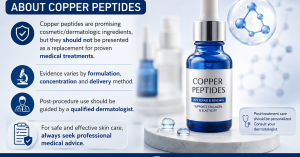
But there is an important distinction between interesting scientific potential and guaranteed cosmetic results.
Copper peptides are not a magic “anti-aging cure.” They are better understood as one possible component of a well-designed skincare strategy.
This guide explains what copper peptides are, what they do, why people use them, when they may be appropriate, how they are used, what to expect, and when professional dermatological advice is important.
- What Are Copper Peptides?
Copper peptides are complexes formed when a peptide binds with copper ions.
One of the best-known examples is GHK-Cu, also called copper tripeptide-1 in cosmetic contexts.
GHK stands for:
Glycine
Histidine
Lysine
GHK naturally occurs in the human body, and research has investigated its interaction with copper and its possible role in tissue remodeling and skin repair. �Blue Booster Copper Peptides for Skin
PubMed
The reason copper peptides have become interesting in skincare is that copper itself is an important trace element involved in multiple biological processes.
Recent dermatological literature continues to examine the roles of copper and zinc in skin healing, including processes involved in inflammation, tissue formation, re-epithelialization and extracellular-matrix remodeling. �
PubMed
However, this does not mean that applying any copper-containing skincare product automatically produces dramatic regeneration.
The actual effect depends on:
The specific peptide
The formulation
Concentration
Stability
Delivery system
Skin condition
Frequency of use
Other skincare products
Individual tolerance
This is why product quality and appropriate use matter.
- What Do Copper Peptides Do for Skin?
The major interest in Copper Peptides for Skin comes from their relationship with processes involved in skin repair and remodeling.
Research on GHK-Cu has described effects involving fibroblasts, collagen-related processes, extracellular-matrix components and wound-healing mechanisms. �
PubMed +1
In simple terms, the potential benefits being investigated include:
Collagen Support
Collagen provides structural support to the skin.
As we age, changes in collagen production and organization contribute to:
Fine lines
Wrinkles
Reduced firmness
Loss of elasticity
Changes in skin texture
Copper peptides have been studied for their potential relationship with collagen synthesis and extracellular-matrix remodeling. �
PubMed +1
Skin Repair Support
GHK-Cu has been investigated for its role in wound-healing and tissue-remodeling pathways.
This is one reason copper peptides are often discussed in regenerative skincare.
However, cosmetic skincare should not be confused with medical wound treatment.
An open wound, infected lesion, burn or surgical wound requires appropriate medical care rather than simply applying a cosmetic peptide serum.
Skin Firmness
Because collagen and extracellular-matrix integrity contribute to skin structure, copper peptides are often used in anti-aging skincare routines aimed at improving the appearance of firmness.
The evidence for topical peptides overall is encouraging but not uniform. A 2026 systematic review and meta-analysis of randomized trials found that peptide interventions were generally well tolerated, while effects varied across outcomes and formulations. �
PubMed
Texture
Healthy-looking skin depends on more than pigmentation.
Texture can be influenced by:
Hydration
Barrier function
Collagen structure
Sun exposure
Age
Inflammation
Acne scarring
Environmental stress
Copper peptides may be incorporated into routines designed to support overall skin quality rather than provide an instant cosmetic effect.
- Why Are Copper Peptides Called a “Regenerative” Ingredient?
The word regenerative sounds powerful, but it needs to be understood correctly.
In dermatology, skin regeneration involves coordinated biological processes.
When skin is injured, the body goes through overlapping phases involving:
Hemostasis
Inflammation
Proliferation
Re-epithelialization
Extracellular-matrix remodeling
Copper and peptide biology has been investigated in relation to several components of these processes. Recent reviews describe copper as a trace element involved in physiological processes associated with wound healing. �
PubMed
GHK-Cu research has also investigated effects involving fibroblasts, collagen and extracellular-matrix remodeling. �
But “regenerative skincare” should never be interpreted as:
“This product can completely rebuild damaged skin.”
That would overstate the evidence.
A more accurate description is:
Copper peptides may support biological processes associated with skin repair and remodeling, depending on the formulation and individual circumstances.
- Copper Peptides and Collagen: What Is the Connection?
Collagen is one of the major structural proteins in the skin.
Think of collagen as part of the framework that helps skin maintain:
Strength
Firmness
Structure
Elasticity
With increasing age and cumulative environmental exposure, the skin’s extracellular matrix changes.
Sun exposure is particularly important because chronic ultraviolet exposure contributes to photoaging.
This explains why modern anti-aging skincare increasingly focuses on ingredients that support the skin’s structure rather than merely creating a temporary surface effect.
GHK-Cu has been studied for its effects on collagen and other extracellular-matrix components. �
PubMed
However, it is important not to promise a specific percentage of collagen increase from an ordinary cosmetic serum unless that specific product has appropriate human clinical evidence.
- What Are the Main Uses of Copper Peptides?
People may consider Copper Peptides for Skin for several cosmetic goals.
Use 1: Anti-Aging Skincare
Copper peptides may be included in routines targeting visible signs of skin aging such as:
Fine lines
Loss of firmness
Rough texture
Dull appearance
Reduced-looking elasticity
They are generally positioned as a long-term skincare ingredient rather than an instant wrinkle eraser.
Use 2: Supporting Skin Quality
Some people do not necessarily want to “look younger.”
They simply want healthier-looking skin.
That may mean:
Smoother texture
Better-looking firmness
Improved overall skin quality
More resilient-looking skin
A healthier appearance
This is a more realistic way to think about peptide-based skincare.
Use 3: Skin Repair Support
Copper peptides are particularly interesting because of their research connection with tissue repair and remodeling.
But cosmetic copper peptide products should not be used as substitutes for treatment of:
Open wounds
Severe burns
Infections
Surgical complications
Significant ulcers
Deep injuries
Those conditions require medical evaluation.
Use 4: Post-Procedure Skincare
This is one of the areas where people need to be particularly careful.
After procedures such as:
Laser treatments
Microneedling
Chemical peels
Resurfacing procedures
Other controlled skin injuries
the skin barrier may temporarily become more vulnerable.
Although copper peptides are associated with repair-related biological processes, the timing of their use after a procedure depends on the procedure, product formulation and patient’s skin condition.
Do not automatically apply a copper peptide serum immediately after a procedure simply because it is marketed as “regenerative.”
Your dermatologist may recommend a simpler barrier-supportive routine first.
- When Should You Use Copper Peptides?
There is no universal schedule that works for everyone.
For a healthy adult using a topical copper peptide product, the manufacturer’s instructions and dermatologist recommendations should guide frequency.
Many people prefer peptide products in their evening routine because nighttime skincare is convenient and can reduce the number of potentially irritating actives used together.
But the most important issue is not whether you use copper peptides at 8 PM or 10 PM.
The important factors are:
Consistency
Tolerance
Product quality
Correct application
Compatibility with your routine
Sun protection
- How to Add Copper Peptides to a Skincare Routine
A simple routine may look like this:
Morning
Step 1: Gentle cleanser
Step 2: Hydrating product if needed
Step 3: Appropriate treatment serum
Step 4: Moisturizer
Step 5: Broad-spectrum sunscreen
Evening
Step 1: Gentle cleanser
Step 2: Copper peptide product
Step 3: Moisturizer
This is only a general framework.
Your dermatologist may modify it depending on whether you have:
Acne
Rosacea
Melasma
Sensitive skin
Eczema
Post-procedure skin
Hyperpigmentation
Active inflammation
- Can Copper Peptides Be Used Every Day?
Potentially, yes—but not everyone needs daily use immediately.
If you are new to a copper peptide product, introducing it gradually can help you determine how your skin responds.
A basic approach may be:
Week 1: Use intermittently according to product directions.
Week 2 onward: Increase frequency if your skin tolerates it.
This is not a prescription schedule. The appropriate frequency depends on the specific formulation.
If you develop persistent irritation, burning, swelling or a significant rash, stop the product and seek appropriate medical advice.
- Copper Peptides vs. Retinoids
Copper peptides and retinoids are not identical ingredients.
Retinoids have a much longer history of dermatological use for photoaging and acne-related indications.
Copper peptides are generally discussed more in the context of:
Skin repair
Extracellular-matrix support
Peptide-based skincare
Skin quality
Anti-aging formulations
They should not automatically be considered replacements for retinoids.
Instead, skincare should be personalized around the person’s goals and tolerance.
- Copper Peptides vs. Vitamin C
Vitamin C is another popular ingredient used in skincare.
It is commonly associated with antioxidant protection and support for collagen-related processes.
Copper peptides have a different biological profile.
Rather than asking:
“Which ingredient is better?”
a more useful question is:
“Which ingredient fits my skin goals and routine?”
For example, someone primarily concerned about photoprotection and antioxidant support may prioritize a different routine than someone focused on barrier recovery and overall skin quality.
A dermatologist can help determine the best combination.
- Can Copper Peptides Brighten or Whiten Skin?
This is an important distinction.
Copper peptides should not primarily be marketed as a skin-whitening ingredient.
Their main interest is related to skin quality, repair-associated processes and extracellular-matrix biology.
If someone has:
Melasma
Post-inflammatory hyperpigmentation
Sun spots
Uneven pigmentation
they may need a targeted pigmentation plan involving appropriate sunscreen and evidence-based treatments.
Calling copper peptides a “whitening treatment” can create unrealistic expectations.
The goal should be healthy, even-looking skin, not unsafe skin lightening.
- Can Copper Peptides Help With Fine Lines?
They may help support the appearance of skin quality over time, but expectations should remain realistic.
Fine lines develop through multiple processes including:
Intrinsic aging
UV exposure
Collagen changes
Repetitive facial movement
Dehydration
Environmental factors
No single serum can reverse every mechanism involved.
Research on GHK-Cu has reported effects on skin firmness, elasticity, wrinkles and photodamage, but much of the literature includes experimental or formulation-specific evidence. �
PubMed +1
That means copper peptides may be one part of an anti-aging strategy, rather than the entire strategy.
- Are Copper Peptides Safe?
Topical peptides are generally considered promising and well tolerated, but “natural” or “cosmetic” does not mean universally risk-free.
Potential problems may include:
Irritation
Redness
Stinging
Dryness
Sensitivity to other products
Contact reactions
A 2026 systematic review of oral and topical peptides reported generally good tolerability across included trials, while also emphasizing variability in outcomes and the need for larger, standardized research. �
PubMed
The safety of a specific product depends on the entire formulation—not simply the words “copper peptide” on the label.
- Who Should Be More Careful?
Professional advice is especially valuable if you have:
Very sensitive skin
Active dermatitis
Rosacea
Significant acne inflammation
A damaged skin barrier
Recent cosmetic procedures
A history of cosmetic allergies
Persistent unexplained skin reactions
If your skin is currently inflamed, introducing multiple active ingredients at once can make it difficult to identify what is causing irritation.
A simpler routine may be more appropriate until the skin barrier settles.
- Copper Peptides After Laser or Microneedling: What You Need to Know
This is one of the most searched questions.
After procedures, people often want something that will “speed up healing.”
But post-procedure skincare should be individualized.
The fact that GHK-Cu has been studied in relation to wound healing does not mean every copper peptide serum is appropriate for freshly treated skin.
After a procedure, the dermatologist may prioritize:
Barrier protection
Hydration
Gentle cleansing
Appropriate wound care
Infection prevention
Sun protection
Only after considering the condition of the skin should additional active products be introduced.
The newer literature continues to investigate copper and peptide mechanisms in wound repair, but research findings should not be translated directly into a universal post-procedure protocol. �
PubMed +1
- Can Copper Peptides Be Used With Other Skincare Ingredients?
This depends on the formulation.
One of the biggest mistakes in advanced skincare is trying to combine every trending active at the same time.
A routine containing:
Retinoids
Acids
Vitamin C
Copper peptides
Exfoliating enzymes
Benzoyl peroxide
Multiple brightening agents
may become unnecessarily complicated.
More products do not automatically mean better skin.
A dermatologist can help decide which actives are genuinely necessary.
The goal should be:
effective + tolerable + sustainable.
- What Should You Look for in a Copper Peptide Product?
If you are considering Copper Peptides for Skin, don’t choose solely because the bottle looks premium or the marketing says “regenerative.”
Consider:
- Ingredient Transparency
Look for clear ingredient information.
- Formulation Stability
Peptides can be sensitive to formulation conditions, so stability and packaging matter.
- Reputable Manufacturer
Choose products from reputable companies with appropriate quality control.
- Clear Instructions
The product should provide directions for use.
- Realistic Claims
Be cautious about claims such as:
“Instantly rebuilds collagen”
“Erases wrinkles”
“Regenerates skin overnight”
“Reverses aging completely”
Skin biology is much more complicated.
- How Long Does It Take to See Results?
Copper peptides are not generally an overnight treatment.
The visible improvement from skincare depends on:
Starting skin condition
Product formulation
Frequency
Overall routine
Sun exposure
Age
Lifestyle
Other treatments
Some people may notice improved hydration or texture relatively quickly.
Changes involving firmness and overall skin quality generally require more time.
The best approach is to assess the skin over several weeks rather than judging the product after one or two applications.
- What Makes a Dermatologist-Guided Approach Different?
Skincare shopping starts with:
“What product should I buy?”
A dermatology approach starts with:
“What is happening to your skin?”
For example, dullness could be caused by:
Dehydration
Sun damage
Irritation
Poor barrier function
Hyperpigmentation
Acne
Inflammation
Likewise, “aging skin” may actually involve:
Volume loss
Dynamic wrinkles
Photoaging
Dryness
Pigmentation
Texture changes
A copper peptide serum cannot solve every one of these problems.
- Copper Peptides for Different Age Groups
In Your 20s
The focus may be:
Prevention
Sunscreen
Barrier health
Basic hydration
Avoiding unnecessary irritation
Copper peptides may be optional rather than essential.
In Your 30s
Some people begin focusing more on:
Fine lines
Texture
Collagen-supportive skincare
Sun damage
Early loss of firmness
Copper peptides may become one possible addition.
In Your 40s and 50s
Skin changes may become more noticeable.
A comprehensive routine may address:
Collagen decline
Dryness
Fine lines
Pigmentation
Loss of firmness
Photodamage
Copper peptides may be considered as part of a broader strategy.
60+
Skin becomes increasingly dependent on gentle barrier care and appropriate dermatological management.
Peptides may still have a role, but skincare should be individualized.
- Copper Peptides for Men
Skincare is not exclusively a women’s concern.
Men may also experience:
Photoaging
Fine lines
Uneven texture
Acne scars
Post-shaving irritation
Loss of firmness
A copper peptide product may fit into a simple routine without requiring a complicated multi-step regimen.
For many men, a practical routine is:
Cleanser → Treatment → Moisturizer → Sunscreen
Consistency matters more than having a bathroom shelf full of products.
- Copper Peptides for Sensitive Skin
Sensitive skin requires additional caution.
If your skin frequently burns or becomes red after skincare products, start slowly.
Avoid introducing several new products simultaneously.
A useful strategy is:
Keep the basic routine stable.
Introducing one new product.
Monitor the skin.
Stop if significant irritation develops.
Seek professional advice if symptoms persist.
Remember that a “stronger” sensation does not mean a product is working better.
- Can Copper Peptides Improve Skin Resilience?
This is one of the more interesting concepts.
Healthy skin must continuously respond to environmental stress.
The skin barrier protects against:
Water loss
Irritants
Microorganisms
Environmental exposure
Meanwhile, the deeper skin structure helps maintain firmness and resilience.
Research into copper and GHK-Cu has focused on biological processes associated with repair and remodeling. �
PubMed +1
So rather than thinking:
“Copper peptides make me look younger instantly,”
think:
“They may support processes involved in maintaining healthy-looking skin over time.”
That is a much more scientifically responsible interpretation.
- Copper Peptides and Post-Inflammatory Skin
After acne or irritation, the skin may develop:
Red marks
Brown pigmentation
Uneven texture
Barrier disruption
Copper peptides may be useful as part of an overall skin-quality routine, but they are not a universal treatment for post-inflammatory pigmentation.
For pigmentation, sun protection is fundamental.
Treatment may also require targeted dermatological options depending on the diagnosis.
- Copper Peptides and Acne-Prone Skin
Copper peptides are not primarily an acne medication.
If someone has active acne, the priority should be controlling the underlying acne process.
Depending on the diagnosis, evidence-based acne management may involve:
Gentle cleansing
Appropriate topical medications
Retinoids
Benzoyl peroxide
Other dermatologist-recommended treatments
Copper peptides may potentially be an additional skincare ingredient, but they should not replace acne treatment.
- Are Copper Peptides a Medical Treatment?
This depends on the product and its intended use.
A cosmetic copper peptide serum is not automatically a medical treatment.
The distinction matters.
A cosmetic product may be designed to:
Condition the skin
Improve appearance
Support hydration
Support overall skin quality
Medical treatment is different and may require:
Diagnosis
Prescription medication
Procedures
Clinical monitoring
Consumers should therefore avoid interpreting cosmetic marketing claims as medical guarantees.
- What Does the Scientific Research Say?
The science behind copper peptides is interesting, but it should be interpreted carefully.
A foundational review of GHK-Cu described mechanisms involving collagen, glycosaminoglycans, fibroblasts and tissue remodeling. �
PubMed
Another review described GHK-Cu as a copper-binding peptide associated with multiple tissue-remodeling processes and summarized research involving skin firmness, elasticity, fine lines and photodamage. �
PubMed
More recent literature continues to investigate copper’s role in wound healing and skin repair. �
PubMed
A 2025 review of tripeptides also discussed mechanisms involving fibroblast migration, collagen deposition, angiogenesis and extracellular-matrix remodeling, while emphasizing the need for improved delivery systems and further research. �
PubMed
Most importantly, a 2026 systematic review of randomized trials on oral and topical peptides found that peptide interventions can be promising and generally well tolerated, but outcomes were inconsistent across measures and larger standardized trials remain necessary. �
PubMed
Therefore, the most accurate conclusion is:
Copper peptides are scientifically interesting and potentially useful, but the strength of evidence depends heavily on the exact formulation and clinical context.
- Why “More Copper” Does Not Mean “Better Skin”
This is a critical point.
Copper is an essential trace element, but skincare is not about simply adding more copper.
Biological systems require balance.
A cosmetic copper peptide is a specific molecular complex—not equivalent to randomly applying copper-containing substances.
That is why DIY copper skincare is not recommended.
Use professionally formulated products with known ingredients and appropriate directions.
- Common Mistakes When Using Copper Peptides
Mistake 1: Expecting Instant Results
Skin remodeling takes time.
Mistake 2: Using Too Many Actives
More actives can increase irritation.
Mistake 3: Ignoring Sunscreen
No anti-aging serum can compensate for uncontrolled UV exposure.
Mistake 4: Using It on Damaged Skin Without Advice
Freshly treated or damaged skin may need specialized care.
Mistake 5: Believing “Regeneration” Means “Healing Everything”
Copper peptides are not a universal wound-healing treatment.
Mistake 6: Buying Based Only on Marketing
Ingredient quality and formulation matter.
Mistake 7: Treating Every Skin Problem as Aging
Pigmentation, acne, rosacea and dermatitis require different approaches.
- Frequently Asked Questions About Copper Peptides
What are Copper Peptides for Skin?
Copper peptides are peptide-copper complexes used in skincare formulations, particularly for their potential association with skin repair, extracellular-matrix remodeling and collagen-related processes.
What is GHK-Cu?
GHK-Cu is a copper complex involving the tripeptide GHK—glycine, histidine and lysine. It has been researched in relation to tissue remodeling and skin repair. �
PubMed
Do copper peptides stimulate collagen?
Research suggests GHK-Cu can influence collagen-related and extracellular-matrix processes, but the magnitude of benefit from a particular topical cosmetic product depends on its formulation and clinical evidence. �
PubMed +1
Are copper peptides good for wrinkles?
They may support the appearance of firmness, texture and fine lines over time, but they should not be considered an instant wrinkle treatment.
Can I use copper peptides every day?
Some formulations are designed for regular use, but follow the product instructions and introduce the product gradually if your skin is sensitive.
Can copper peptides replace retinol?
No. They have different properties and evidence bases. A dermatologist can determine which ingredients are appropriate for your goals.
Can copper peptides whiten skin?
Copper peptides are not primarily a skin-whitening treatment. They are better discussed in terms of skin quality, repair-associated processes and anti-aging skincare.
Can I use copper peptides after laser treatment?
Possibly, but timing matters. Ask your treating dermatologist before applying active products to recently treated skin.
Are copper peptides safe?
Topical peptides are generally promising and well tolerated, but irritation or sensitivity can occur. Product formulation and individual skin condition matter. �
PubMed
How long do copper peptides take to work?
Visible results vary. Consistent use over time is more realistic than expecting immediate transformation.
Are copper peptides suitable for sensitive skin?
They may be, but sensitive or inflamed skin should be approached cautiously. Introduce one product at a time.
Can copper peptides help damaged skin?
They may support pathways associated with skin repair, but significant skin damage or wounds require appropriate medical evaluation rather than cosmetic skincare alone.
- Who May Consider Copper Peptides?
Copper peptides may be worth discussing with a dermatologist if you are interested in:
Long-term skin-quality support
Fine-line care
Firmness
Texture
Skin resilience
Post-aging skincare
A peptide-based skincare routine
They may be particularly interesting for people who want a skincare routine focused on skin health rather than quick cosmetic effects.
- When Should You See a Dermatologist Instead of Buying Another Serum?
If you have persistent:
Redness
Itching
Burning
Acne
Pigmentation
Sudden skin changes
Unexplained rash
Scarring
Poor wound healing
a dermatologist can identify the underlying condition.
For example, what looks like “dry aging skin” could actually be dermatitis.
What looks like “dark spots” could be melasma.
What looks like “acne scars” may require a combination of treatments.
Correct diagnosis comes before choosing the serum.
- Copper Peptides Near Me: How to Choose a Dermatologist
For people searching online for:
“Copper Peptides near me”
“Dermatologist near me”
“Skin clinic near me”
the goal should not simply be finding the closest clinic.
Look for a qualified dermatology professional who can evaluate:
Your skin type
Your skin condition
Your current products
Previous procedures
Your goals
Potential interactions
Whether copper peptides are actually necessary
This is particularly important when combining skincare with procedures.
For USA patients, a dermatologist can also help distinguish cosmetic skincare from treatments that may require medical supervision.
- A Simple USA-Friendly Copper Peptide Skincare Strategy
For a typical adult interested in anti-aging skincare, a basic approach may be:
Morning
Cleanser → Moisturizer → Broad-spectrum sunscreen
Evening
Cleanser → Copper peptide serum → Moisturizer
Then, if medically appropriate, other treatments can be introduced separately.
This minimalist approach is often easier to maintain than a 10-step routine.
For people using prescription retinoids or other active treatments, the schedule should be individualized.
- Why Sunscreen Still Matters Most
It is easy to get excited about a new peptide and forget the basics.
But daily sun protection remains foundational for maintaining healthy-looking skin.
UV exposure contributes to photoaging, pigmentation and collagen-related skin changes.
So even if someone uses:
Copper peptides
Retinoids
Vitamin C
Hyaluronic acid
Ceramides
Growth-factor products
they should still pay attention to sun protection.
Skincare works best as a system, not as one miracle ingredient.
- The Future of Peptide-Based Skincare
The science of peptides is still developing.
Researchers are investigating:
Better peptide stability
Improved delivery systems
Combination formulations
Targeted tissue repair
Skin regeneration
Extracellular-matrix remodeling
Recent research continues to explore copper-tripeptide complexes and their potential role in wound repair, while emphasizing that additional research is needed before experimental findings become routine clinical treatments. �
PubMed +1
This is exciting because future formulations may deliver peptides more efficiently.
But it also means consumers should distinguish between emerging science and established clinical evidence.
- The Bottom Line: Are Copper Peptides Worth Trying?
For many skincare users, copper peptides are an interesting ingredient worth discussing.
Their appeal comes from the biological research surrounding:
Tissue remodeling
Collagen-related pathways
Fibroblast activity
Skin repair
Extracellular-matrix processes
Research supports a scientific rationale for further investigation, and recent reviews continue to explore their role in skin healing and peptide-based skincare. �
PubMed +2
But the right message is not:
“Copper peptides will transform everyone’s skin.”
The better message is:
“Copper peptides may support healthier-looking, more resilient skin as part of an individualized skincare routine.”
That distinction matters.
Conclusion: Healthy Skin Is More Than Looking Younger
The modern approach to skincare is moving toward skin quality, resilience and long-term health.
Copper peptides are part of that conversation because of their interesting relationship with tissue remodeling, collagen-associated processes and skin repair.
For someone experiencing dullness, fine lines, reduced firmness or concerns about overall skin quality, a copper peptide product may be one possible option.
But skincare should never be reduced to a single trending ingredient.
The best routine considers:
Your age
Skin type
Skin condition
Medical history
Current skincare
Sun exposure
Previous procedures
Treatment goals
And if you have recently undergone a cosmetic procedure, professional guidance becomes even more important.
Copper Peptides for Skin may be a promising addition to modern skincare—but healthy skin comes from the right diagnosis, the right routine, consistent protection and realistic expectations.
If you are searching for Copper Peptides near me, a dermatologist near me, or professional guidance for skin rejuvenation, speak with a qualified dermatology professional before introducing advanced active ingredients—especially after procedures.
Skin Perfection Centre can position this topic around dermatologist-guided skin health, personalized skincare and evidence-informed cosmetic dermatology rather than promising instant “whitening” or overnight regeneration.
SEO/AEO FAQ Keywords to Target
What are copper peptides for skin?
What does GHK-Cu do for skin?
Do copper peptides stimulate collagen?
Are copper peptides good for aging skin?
Can copper peptides repair skin?
Can I use copper peptides after laser?
How often should I use copper peptides?
Are copper peptides safe?
Copper peptides near me
Dermatologist near me
Skin rejuvenation near me
Copper peptide treatment in USA
- advanced skin rejuvenation treatments
- regenerative aesthetics and cellular skin longevity
- exosome therapy for skin and hair rejuvenation
- CO2 fractional laser treatment
- melasma and pigmentation treatment
- advanced anti-aging and skin tightening treatments
- microneedling for collagen stimulation
Evidence note: The article intentionally uses cautious language because research on peptides is promising but formulation-specific, and a 2026 systematic review found that benefits across topical/oral peptide studies were variable and that larger standardized trials are still needed. �
PubMed