

Introduction: What Is Exosome Therapy?
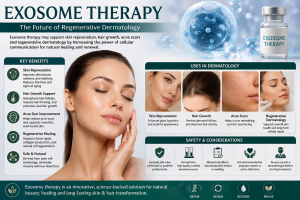
Exosome therapy is becoming one of the most discussed innovations in regenerative dermatology. From Exosomes for Skin and facial rejuvenation to Exosome Treatment for Hair Loss, researchers are exploring how extracellular vesicles may support tissue repair and cellular communication.
Exosomes are tiny extracellular vesicles released by cells. They can carry proteins, lipids and other biological signals that influence communication between cells. This has created interest in their potential role in skin remodeling, wound healing and hair follicle biology.
However, it is important to separate scientific potential from marketing claims. Exosome therapy is still an emerging field, and different products can vary considerably in their source, manufacturing, purification, concentration and characterization.
A 2026 systematic review and meta-analysis of human aesthetic studies found encouraging improvements in several skin and hair outcomes, but also emphasized heterogeneity and non-standardized protocols.
Why Are Exosomes Important in Regenerative Dermatology?
Traditional cosmetic treatments often focus on improving the visible appearance of the skin. Regenerative approaches aim to support biological processes involved in repair and remodeling.
Exosomes are being investigated because their biological cargo may influence pathways associated with:
Cellular communication
Collagen production
Tissue repair
Inflammation
Angiogenesis
Skin regeneration
Hair follicle activity
This makes Exosome Therapy in Aesthetics an interesting research area for dermatologists and aesthetic practitioners.
A 2024 review of cosmetic dermatology literature reported potential applications in wound healing, scar prevention, skin regeneration, photodamage and hair loss, while also highlighting limitations such as inconsistent protocols and limited clinical evidence.
What Are Exosomes Used For?
1. Exosomes for Skin Rejuvenation
Exosome Skin Rejuvenation is being explored for improving skin texture, elasticity, pigmentation and signs of photodamage.
Some clinical studies suggest potential improvements in wrinkles, elasticity, pigmentation and overall skin appearance. A 2026 meta-analysis reported measurable improvements across several aesthetic skin outcomes, although researchers noted that differences between protocols limit how broadly the results can be applied.
2. Exosome Treatment for Hair Loss
Hair restoration is another major area of research.
Exosome Hair Growth therapies are being investigated particularly for androgenetic alopecia and other forms of nonscarring hair loss. Researchers are interested in whether exosome-derived signaling can influence dermal papilla cells, inflammation and hair follicle activity.
A 2025 systematic review identified 11 clinical studies involving exosome therapy for hair loss. Although improvements in hair density and thickness were reported, the authors emphasized small sample sizes, different exosome sources and inconsistent protocols.
Therefore, Exosome Treatment for Hair Loss should currently be viewed as an emerging regenerative approach rather than a guaranteed cure for baldness.
3. Exosomes for Acne Scars
Exosomes for Acne Scars are being investigated as part of skin remodeling strategies.
The concept is particularly interesting when regenerative products are studied alongside procedures that intentionally stimulate controlled skin repair. However, evidence is still developing, and treatment should be individualized according to scar type, skin condition and the procedure being used.
4. Exosome Facial and Skin Rejuvenation
An Exosome Facial may refer to different protocols depending on the clinic and product.
Some providers combine topical preparations with procedures such as microneedling or other forms of controlled skin stimulation. Because the term “exosome facial” is not a standardized medical treatment, patients should ask exactly what product is being used and how it is manufactured.
5. Exosomes for Pigmentation and Dark Circles
Researchers are also investigating Exosomes for Pigmentation and Exosome Therapy for Dark Circles.
These applications remain less established than their marketing popularity may suggest. Pigmentation has many causes, including melasma, post-inflammatory hyperpigmentation and photodamage. The underlying diagnosis should be established before selecting any regenerative treatment.
6. Exosomes for Stretch Marks
Exosomes for Stretch Marks represent another developing application.
Because stretch marks involve changes in collagen and dermal structure, regenerative approaches are being studied for their potential role in improving skin remodeling. However, patients should have realistic expectations because established treatments may still be required depending on the age and severity of the stretch marks.
What Is Exosome Microneedling?
Exosome Microneedling combines controlled micro-injury with an exosome-based topical product.
The theory is that microneedling creates temporary pathways and stimulates the skin’s natural repair response, while the applied product may provide additional biological signals.
However, the exact benefits depend on the device, technique, product and protocol. The phrase “exosome microneedling” therefore should not be interpreted as one standardized treatment.
What About Exosome Nano Infusion and Mesotherapy?
Exosome Nano Infusion and Exosome Mesotherapy are terms used for protocols designed to deliver regenerative products into or onto the skin.
Again, these terms can describe different procedures in different clinics. Patients should ask whether the product is actually characterized as an exosome preparation, an extracellular-vesicle product, conditioned media or another cosmetic formulation.
Clear terminology matters because “exosome” is not a single standardized product.
Can Exosomes Be Combined With Other Dermatology Procedures?
Exosome-based products are sometimes marketed for use following procedures such as:
Microneedling
MNRF
Fractional laser treatments
CO2 laser procedures
Other skin-remodeling treatments
Exosomes After CO2 Laser and MNRF with Exosomes are examples of combination approaches being explored in aesthetic practice.
The rationale is that controlled procedures stimulate repair, while regenerative products may potentially influence the healing environment. However, combination treatments require appropriate medical assessment, particularly regarding skin type, inflammation, infection risk and post-procedure care.
When Should You Consider Exosome Therapy?
There is no single ideal time for everyone.
A qualified dermatologist or medical aesthetic professional should first determine:
What skin or hair concern is being treated?
Is there a clinically established diagnosis?
Is exosome therapy appropriate for that concern?
What exact product will be used?
What is the source and manufacturing process?
What clinical evidence supports the specific product and procedure?
Are there safer or better-established alternatives?
This approach is particularly important because commercial exosome products can differ substantially.
Is Exosome Therapy FDA Approved?
This is one of the most important questions patients should ask.
The U.S. FDA states that there are currently no FDA-approved exosome products. The agency has also warned about serious adverse events associated with unapproved products marketed as containing exosomes.
The FDA further explains that exosome products intended to treat diseases or medical conditions in humans are generally subject to regulatory requirements.
This does not mean that research into exosomes has no potential. Instead, it highlights why patients should distinguish between clinical research, regulated medical products and commercially marketed treatments.
What Should Patients Ask Before Treatment?
Before undergoing Exosome Therapy, consider asking:
What exactly is the product?
What is its biological source?
How is it manufactured and purified?
Is the product sterile and appropriately tested?
Is the product intended for topical or procedural use?
What clinical evidence supports this specific preparation?
What are the possible risks and side effects?
Who is performing the procedure?
Is the treatment approved or being offered under an appropriate regulatory pathway in my country?
Transparency is an important part of responsible regenerative dermatology.
The Future of Exosome Therapy
The future looks promising, but it is too early to describe exosomes as a universally proven replacement for established dermatological treatments.
Recent research is encouraging. A 2026 meta-analysis of 39 human aesthetic studies reported improvements in wrinkles, pigmentation, elasticity, texture, hair density and hair thickness. However, the researchers also identified heterogeneity between studies and non-standardized protocols as important limitations.
Another 2026 review noted that clinical adoption remains limited by challenges involving manufacturing standardization, regulatory frameworks and long-term efficacy data.
Future research should therefore focus on standardized products, well-designed randomized clinical trials, transparent characterization and long-term safety monitoring.
FAQs
What is Exosome Therapy?
Exosome Therapy is an emerging regenerative approach involving extracellular vesicles that can carry biological signals between cells. It is being investigated for skin rejuvenation, hair restoration and tissue repair.
Does Exosome Therapy regrow hair?
Early human studies report improvements in hair density and thickness, but evidence remains limited and heterogeneous. Exosome therapy should not currently be presented as a guaranteed hair-loss cure.
Are exosomes good for skin?
Research suggests potential benefits for skin texture, pigmentation, elasticity, wrinkles and regeneration. However, the strength of evidence depends on the specific product and treatment protocol.
What is Exosome Microneedling?
It generally refers to applying an exosome-based or extracellular-vesicle product in conjunction with microneedling. Protocols vary between providers, so patients should ask what exact product is being used.
Are exosome products FDA approved?
The FDA states that there are currently no FDA-approved exosome products in the United States.
Can exosomes help acne scars?
Exosomes are being researched for skin regeneration and scar remodeling, but evidence is still developing. Treatment should be selected according to the type and severity of the scar.
Are exosomes the future of regenerative dermatology?
They may become an important part of regenerative dermatology, particularly for hair and skin applications. However, stronger clinical evidence, standardized manufacturing and appropriate regulation are needed before their full potential can be established.
Conclusion
Exosome Therapy represents an exciting frontier in regenerative dermatology. Research is exploring its potential for Exosomes for Skin, Exosome Hair Growth, Exosomes for Acne Scars, Exosome Facial treatments, pigmentation, skin rejuvenation and procedure-assisted remodeling.
The science is promising, but responsible medicine requires more than promising results. Product quality, manufacturing standards, clinical evidence, patient selection and regulatory oversight are essential.
For patients, the best approach is not to ask simply, “Are exosomes the future?” but rather:
“Is this specific exosome product, protocol and treatment appropriate for me, and what evidence supports it?”
As research continues, exosomes may become an increasingly valuable tool in regenerative dermatology—but their future should be built on evidence, safety and transparency rather than hype.