
Viral Warts Treatment in Lahore | Laser Wart Removal | Skin Perfection Centre
While many eventually disappear without treatment, persistent, painful, recurrent, or cosmetically troublesome warts may benefit from professional dermatological treatment.
If you are looking for viral warts treatment, laser wart removal, or a dermatologist for warts in Lahore, the right approach begins with confirming the diagnosis and choosing treatment according to the wart’s type, location, thickness, number, skin type, previous treatments, pain tolerance, and recurrence history.
What Are Viral Warts?
Viral warts are benign skin lesions caused by infection with certain types of human papillomavirus (HPV). HPV can enter the skin through small cuts, abrasions, or areas where the skin barrier has been disrupted.
Warts can appear on different parts of the body and may vary considerably in appearance.
Some are small and smooth, while others are thick, rough, clustered, or located around the nails. Plantar warts on the feet can sometimes become painful because pressure pushes them inward.
Although warts are usually harmless, they can spread from one area of the body to another or, in some circumstances, from one person to another.
What Causes Viral Warts?
The main cause of common viral warts is HPV infection of the skin.
However, developing a wart is not simply a matte HPV infection of the skin.r of being exposed to HPV. Several factors can influence whether the virus establishes an infection and whether a wart persists.
Potential contributing factors include:
Viral Warts Treatment in Lahore
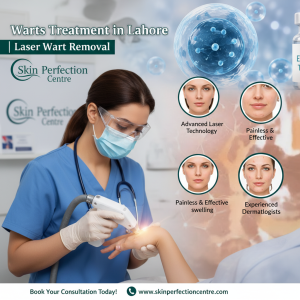
- Direct skin-to-skin contact
- Contact with contaminated surfaces
- Small cuts or breaks in the skin
- Nail biting or picking around the nails
- Moisture and maceration of the skin
- Repeated friction or trauma
- Individual immune response
- Personal susceptibility to HPV infection
It is important not to incorrectly attribute ordinary viral warts to unrelated conditions. For example, hepatitis B or C and diet should not be presented as direct causes of common skin warts.
Certain immune-related conditions can be clinically relevant because the immune system plays an important role in controlling HPV infections. Diabetes or a weakened immune system may also affect how persistent or difficult-to-treat a lesion becomes in some patients.
Types of Warts
Understanding the types of warts helps a dermatologist select an appropriate treatment.
1. Common Warts
Viral Warts Treatment in Lahore
Common warts usually appear as rough, raised growths on the hands, fingers, elbows, knees, or other areas.
They may have a grainy or cauliflower-like surface and can occur as individual lesions or multiple growths.
2. Plantar Warts
Plantar warts develop on the soles of the feet.
Because walking places pressure on them, they can become uncomfortable or painful. They may also develop thickened surrounding skin, making them resemble a callus.
3. Flat Warts
Viral Warts Treatment in Lahore

Flat warts are generally smaller and smoother than common warts. They can occur in groups and are often found on the face, hands, or legs.
Because they may be numerous and relatively subtle, professional assessment can be particularly useful when the diagnosis is uncertain.
4. Periungual Warts
Periungual warts occur around or underneath the fingernails and toenails.
These lesions can be challenging to treat because aggressive treatment may potentially damage the nail or surrounding structures. Treatment should therefore be carefully selected.
5. Other HPV-Related Warts
Some HPV-related lesions occur in specialized areas, including the genital region. Genital lesions require appropriate professional assessment because their diagnosis, management, and transmission considerations differ from those of ordinary hand or foot warts.
Do Viral Warts Go Away on Their Own?
Yes. Some viral warts resolve spontaneously as the immune system recognizes and controls the HPV infection.
However, spontaneous resolution can take months or even years, and not every wart disappears without treatment.
Treatment may be considered when a wart:
- Persists for a long time
- Becomes painful
- Spreads or increases in number
- Interferes with daily activities
- Causes significant cosmetic concern
- Repeatedly returns
- Has not responded to previous treatment
Viral Warts Treatment Options
There is no single best wart treatment for every patient.
A dermatologist may consider one or more approaches depending on the diagnosis and characteristics of the lesion.
Common options include:
- Salicylic acid
- Cryotherapy
- Laser treatment
- Electrosurgery
- Radiofrequency-based treatment
- Intralesional therapies
- Immunotherapy
- Combination treatment
Treatment may require multiple sessions, particularly when the wart is thick, extensive, recurrent, or resistant to previous therapies.
Energy-Based Devices for Wart Treatment
For persistent or cosmetically troublesome lesions, dermatologists may consider energy-based technologies as part of an individualized treatment plan.
These procedures should not be viewed as automatically superior to conventional treatments. The most appropriate method depends on the specific patient and lesion.
CO₂ Laser for Warts
CO₂ laser for warts uses concentrated laser energy to ablate targeted tissue.
Because the treatment can be localized and controlled, CO₂ laser technology has been studied for selected resistant or recalcitrant warts, particularly when conventional treatment has not produced satisfactory results.
The procedure may involve local anesthesia depending on the lesion and treatment area.
After treatment, patients may experience temporary redness, swelling, discomfort, crusting, or changes in pigmentation. Appropriate wound care and infection-control precautions are important.
CO₂ laser treatment is not automatically appropriate for every wart. A dermatologist should first confirm that the lesion is suitable for destructive treatment.
Long-Pulsed Nd:YAG Laser
The long-pulsed Nd:YAG laser has also been investigated for cutaneous warts.
Its mechanism may involve targeting vascular structures associated with the wart and producing controlled thermal effects.
It may be considered in selected thick, persistent, or treatment-resistant lesions.
As with other laser approaches, treatment parameters should be individualized according to lesion characteristics and skin type.
Pulsed Dye Laser
The pulsed dye laser has also been studied as an option for some warts because of its ability to target blood vessels.
However, response can vary, and evidence does not establish pulsed dye laser as a universally superior treatment.
A dermatologist may consider it in selected circumstances based on the location, appearance, and treatment history of the lesion.
Electrosurgery and Radiofrequency
Electrosurgical and radiofrequency-based techniques use controlled thermal energy to destroy abnormal wart tissue.
These approaches may be useful for selected lesions when a precise destructive procedure is appropriate.
Depending on the size and location of the lesion, local anesthesia may be used.
Temporary soreness, crusting, redness, or pigmentary changes can occur after treatment.
Other Emerging Wart Treatments
Research has explored several additional approaches for difficult-to-treat warts.
These include:
- Er:YAG laser
- Photodynamic therapy
- Local hyperthermia
- Microwave-based therapy
- Other emerging energy-based technologies
The evidence and treatment protocols vary considerably between modalities.
A 2024 systematic review found that laser and energy-based approaches can have a role in treating cutaneous verrucae, but available evidence does not establish one universally superior device for every patient.
Therefore, the phrase “best laser for warts” should be interpreted cautiously. The best option depends on the individual lesion rather than simply the name of the device.
Laser Wart Removal: Is It Painless?
Laser wart removal should not automatically be described as painless.
Some patients may experience discomfort during or after treatment. Depending on the procedure, lesion location, and treatment intensity, a dermatologist may use topical or local anesthesia.
Possible temporary effects include:
- Redness
- Swelling
- Tenderness
- Crusting
- Minor bleeding
- Discomfort
- Temporary pigmentation changes
Healing and recovery vary according to the treatment method and location.
Patients should follow the dermatologist’s wound-care instructions carefully after treatment.
How Does a Dermatologist Choose Wart Treatment?
A dermatologist considers several factors before recommending treatment.
These may include:
Wart type: Common, plantar, flat, periungual, or another lesion.
Location: Treatment around the eyes, face, nails, feet, or other sensitive areas may require special considerations.
Number of lesions: A single wart may require a different strategy from numerous lesions.
Thickness: Thick or deeply established lesions can be more difficult to treat.
Previous treatment: Resistant warts may require a different or combined approach.
Skin type: The risk of post-inflammatory pigmentation and other effects can vary between individuals.
Pain tolerance: Some procedures are more uncomfortable than others.
Recurrence history: Recurrent lesions may require reassessment and a broader treatment strategy.
When Should You See a Dermatologist for Warts?
Professional evaluation is especially important if:
- Warts are numerous or rapidly increasing
- A lesion is painful
- A lesion bleeds
- The appearance is changing
- The lesion becomes ulcerated
- Warts persist despite treatment
- Lesions occur on the face
- Lesions occur in the genital area
- The diagnosis is uncertain
- You have diabetes
- You have a weakened immune system
- You are concerned about scarring or pigmentation
- Previous treatments have failed repeatedly
Some skin cancers and other dermatological conditions can resemble warts.
For this reason, destructive treatment should not be performed on an undiagnosed lesion.
When a lesion looks unusual or fails to respond as expected, a dermatologist may occasionally recommend a biopsy.
Can You Remove Warts at Home?
Some uncomplicated warts can be treated with over-the-counter preparations such as salicylic acid.
However, self-treatment is not appropriate for every lesion.
Avoid repeatedly cutting, burning, or aggressively destroying a growth when you are not certain that it is actually a wart.
Extra caution is needed with lesions on the face, around the nails, genital area, or in people with certain medical conditions.
If a lesion is changing, bleeding, painful, or resistant to treatment, professional assessment is preferable.
Can Viral Warts Spread?
Yes. HPV-related warts can spread through direct contact or through contact with contaminated surfaces.
They can also sometimes spread from one area of the body to another, particularly when a person picks or scratches the lesion.
Good hygiene and avoiding unnecessary manipulation of the wart can help reduce the risk of spreading infection.
Do not share personal items that may come into contact with affected skin, particularly when dealing with lesions on the hands or feet.
Can Warts Come Back After Treatment?
Yes.
Treatment removes or destroys the visible lesion, but recurrence can occur because HPV infection may persist in surrounding or deeper skin.
For resistant or recurrent viral warts, a dermatologist may consider:
- A different treatment
- Multiple treatment sessions
- Combination therapy
- Intralesional therapy
- Immunotherapy
- Laser or energy-based treatment
The goal is not simply to remove the visible bump but to develop an appropriate strategy for the individual patient’s condition.
Viral Warts Treatment in Lahore
If you are searching for wart removal in Lahore, choosing a qualified dermatologist is more important than choosing a particular device.
A professional assessment can help determine whether a lesion is actually a viral wart and whether treatment is necessary.
For persistent or resistant lesions, the dermatologist may discuss conventional therapies, cryotherapy, laser treatment, electrosurgery, radiofrequency, intralesional treatment, or combination approaches.
If laser treatment is being considered, the dermatologist can determine whether technologies such as CO₂ laser or Nd:YAG laser for warts are appropriate for the specific lesion.
Frequently Asked Questions
What is the main cause of viral warts?
Viral warts are primarily caused by infection with certain types of HPV. Small breaks in the skin can provide an entry point for the virus.
What are the most common types of warts?
Common types include common warts, plantar warts, flat warts, and periungual warts. Different types can require different treatment approaches.
What is the best treatment for viral warts?
There is no universal best treatment. Options may include salicylic acid, cryotherapy, laser treatment, electrosurgery, intralesional therapies, immunotherapy, or combinations of these approaches.
Does CO₂ laser remove warts?
CO₂ laser can be used to ablate selected wart tissue and has been studied particularly for persistent or resistant lesions. Suitability depends on the individual lesion.
Is laser wart removal painful?
It can cause discomfort. Some procedures require topical or local anesthesia, and temporary soreness, redness, swelling, crusting, or pigmentation changes may occur.
Can plantar warts be treated with a laser?
Yes, selected plantar warts may be treated using laser or other approaches. The appropriate method depends on the lesion’s thickness, location, symptoms, and previous treatment.
Why do my warts keep coming back?
Recurrence can occur because HPV may persist in the skin even after the visible wart has been treated. Resistant warts may require reassessment and combination treatment.
Should I see a dermatologist for a wart?
Yes, especially if the lesion is painful, bleeding, changing, rapidly increasing, persistent, recurrent, located on the face or genital area, or if you are uncertain that it is actually a wart.
Final Takeaway
Viral warts are HPV-related skin infections, not simply cosmetic bumps. Their development and persistence can be influenced by HPV exposure, disruption of the skin barrier, moisture, maceration, immune response, and individual susceptibility.
For persistent or recurrent lesions, modern energy-based approaches—including CO₂ laser, Nd:YAG laser, pulsed dye laser, and selected electrosurgical or radiofrequency techniques—may provide dermatologist-supervised treatment options.
However, no single device is ideal for every patient.
The safest approach is accurate diagnosis followed by individualized treatment from a qualified dermatologist rather than repeatedly attempting destructive treatment on an uncertain lesion.
Book a Dermatology Consultation
If you have persistent, recurrent, painful, or cosmetically troublesome warts and want professional assessment, consult a qualified dermatologist to determine whether conventional treatment, laser wart removal, or another approach is appropriate.
Website: https://skinperfectioncentre.com/
SEO Focus Keyword: Viral warts treatment
Secondary Keywords: viral warts causes, types of warts, HPV warts, common warts, plantar warts, flat warts, periungual warts, wart treatment, laser wart removal, CO₂ laser for warts, Nd:YAG laser warts, pulsed dye laser warts, wart removal in Lahore, dermatologist for warts, resistant viral warts, HPV skin infection
Suggested SEO Title: Viral Warts Treatment in Lahore | Laser Wart Removal & Dermatologist
Suggested Meta Description: Learn about viral warts treatment, HPV wart causes, types, laser wart removal, CO₂ and Nd:YAG