
How CO2 Fractional Laser Works for Acne Scar Treatment
This guide breaks down exactly how this powerful acne scar treatment works, what results to realistically expect, and how to care for your skin afterward for the safest, most effective outcome.
Acne scars Treatment and aging skin share a common root cause damaged or depleted collagen. While countless creams and serums promise to “fix” texture and tone, few treatments can actually rebuild the skin’s structural foundation. CO2 fractional laser is one of the few that can — and it’s why dermatologists around the world consider it the gold standard for both acne scar revision and long-term skin rejuvenation.
If you’ve researched laser resurfacing before, you’ve likely come across conflicting information about downtime, results, and safety — especially for deeper skin tones. This guide breaks down exactly how CO2 fractional laser works, what results to realistically expect, and how to care for your skin afterward for the safest, most effective outcome.
What Is CO2 Fractional Laser?
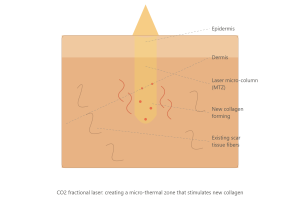
CO2 fractional laser is a resurfacing treatment that uses focused laser energy to create thousands of microscopic columns in the skin, known as Micro Thermal Treatment Zones (MTZs). Unlike older, fully ablative CO2 lasers that resurfaced the entire skin surface at once, the fractional version treats only a fraction of the skin in a precise grid pattern, leaving the surrounding tissue untouched.
This “fractional” approach is what makes modern CO2 laser both powerful and safer. The untreated tissue between each micro-column acts as a reservoir of healthy cells, dramatically speeding up healing compared to traditional full-field resurfacing.
How CO2 Fractional Laser Works on the skin
As one of the most trusted forms of acne scar treatment available today, the process works in four connected stages. The treatment works in four connected stages:
1. *Removal of damaged skin cells* – The laser vaporizes the outermost damaged layer of skin in a controlled, fractional pattern.
2. *Activation of the healing response* – The micro-injuries signal the body to begin a natural wound-healing cascade.
3. *Stimulation of collagen and elastin* – Fibroblasts, the cells responsible for producing collagen and elastin, are activated and multiply.
4. *Tissue remodeling* – Old, damaged tissue is gradually replaced with new, organized collagen, resulting in smoother, firmer, more even-toned skin.
This is why CO2 fractional laser is considered a regenerative treatment rather than a surface-level fix. It doesn’t just remove damaged skin — it rebuilds what’s underneath.
## The Collagen Remodeling Timeline: What Happens Week by Week
One of the most important things to understand about CO2 fractional laser is that results are not immediate. Collagen remodeling is a biological process that unfolds over months, not days.
– *Immediately after treatment:* Controlled micro-injuries activate growth factors and fibroblasts, kickstarting the repair process beneath the skin’s surface.
– *Weeks 1–6:* New collagen and elastin fibers begin forming. Skin may still look and feel like it’s in an active healing phase.
– *Weeks 6–12:* Collagen fibers thicken and organize, and overall skin structure visibly improves — texture looks smoother and scars appear shallower.
– *Months 3 and beyond:* Collagen remodeling matures fully, producing stronger, healthier, firmer, and more youthful-looking skin.
In short: results continue to improve for up to six months after a single session, which is why patience and consistent aftercare matter just as much as the procedure itself.
How CO2 Fractional Laser Treats Acne Scar Treatment
Acne scarring occurs when the skin’s healing process is disrupted during a breakout, often leading to depressed, pitted, or textured scar tissue. CO2 fractional laser addresses this at a structural level by breaking down abnormal, fibrous scar tissue and stimulating fresh collagen to fill in and lift depressed areas.
As an acne scar treatment, CO2 fractional laser addresses scarring at a structural level by breaking down abnormal, fibrous scar tissue.
Because the laser reaches into the dermis — the deeper layer where scar tissue actually forms — it can improve texture in ways that topical treatments simply cannot.
Which Acne Scars Respond Best?
Not all acne scars respond equally to CO2 fractional laser, which is why an accurate diagnosis by an experienced dermatologist is essential before treatment.
| Scar Type | Response to CO2 Fractional Laser | Notes |
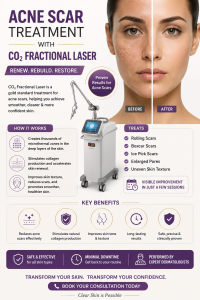
| *Boxcar scars* | Excellent | Broad, well-defined scars typically show significant improvement |
| *Rolling scars* | Excellent | Tethered scars respond very well, especially when combined with subcision |
| *Ice-pick scars* | Moderate | Narrow, deep scars are more challenging; best results often come from combining laser with TCA CROSS or punch techniques first |
| *Hypertrophic (raised) scars* | Less effective | Alternative treatments are usually recommended |
| *Keloid scars* | Less effective | Requires a different treatment approach entirely |
This is why an individualized treatment plan matters more than a one-size-fits-all approach. A dermatologist who properly assesses your scar type — and combines techniques where needed — will always deliver better outcomes than laser alone.
## What to Expect: Recovery Timeline After CO2 Fractional Laser
Understanding the recovery process helps set realistic expectations and reduces anxiety during the healing phase.
### Immediately After Treatment (1–72 Hours)
It’s completely normal to experience:
– Redness
– Warmth
– Mild swelling
– Tightness
– Tiny crusts or a light bronzing effect
– A sensation similar to a mild sunburn
This is your skin actively beginning its healing journey, and it typically settles within a few days.
### Around 3 Weeks
By this stage, most patients notice:
– Smoother skin texture
– Softer-looking acne scars
– Reduced pore size
– A brighter overall complexion
– More even skin tone
– A healthier, natural glow
This is a strong sign that collagen production is actively increasing beneath the surface, even though visible healing may look complete.
### Around 3 Months
This is typically when the most dramatic transformation becomes visible:
– Significant scar reduction
– Firmer, tighter skin
– Noticeably smaller pores
– Improved skin elasticity
– Reduction in fine lines
– Overall skin rejuvenation
The improvement continues beyond this point as collagen remodeling fully matures, meaning your results at three months are not necessarily your final results.
## Why Post-Procedure Care Matters — Especially for Asian Skin
Asian skin tends to be more prone to post-inflammatory hyperpigmentation (PIH), a temporary darkening of the skin that can occur after any inflammatory skin injury, including laser treatment. This makes aftercare not just recommended, but essential for safe healing and optimal results.
*Do:*
– Cleanse gently, avoiding harsh scrubbing
– Use dermatologist-prescribed healing creams
– Apply strict sun protection (SPF 50+), reapplied regularly
– Use dermatologist-recommended moisturizers
*Avoid:*
– Picking, scratching, or peeling at healing skin
– Heat, steam, and direct sunlight exposure
– Harsh exfoliants, retinoids, and active acids until cleared by your provider
Consistent aftercare is directly linked to better healing and better long-term results. Skipping these steps — even for a few days — can increase the risk of complications like pigmentation changes or prolonged redness.
## Beyond Acne Scars treatment: The Multi-Benefit Nature of CO2 Fractional Laser
While acne scar revision is one of the most requested uses of CO2 fractional laser, its benefits extend well beyond scarring. Because the treatment works by remodeling collagen throughout the treated area, patients commonly see improvements in:
– *Anti-aging and wrinkle reduction* – softer fine lines and improved skin firmness
– *Skin tightening and lifting* – firmer, more structurally supported skin
– *Pore refinement* – visibly smaller, less noticeable pores
– *Improved texture and tone* – smoother overall skin surface
– *Brighter complexion* – more even, radiant-looking skin
– *Neck rejuvenation* – the same collagen-building benefits applied to neck skin
This makes CO2 fractional laser a versatile option for anyone looking to address multiple skin concerns in a single treatment approach, rather than acne scarring alone.
## Enhancing Results with Regenerative Boosters
One advantage unique to CO2 fractional laser is the network of micro-channels it creates in the skin. These channels temporarily improve the skin’s ability to absorb topical therapeutic solutions, which is why many dermatologists pair the treatment with regenerative boosters for enhanced results:
– *Platelet-Rich Plasma (PRP):* Speeds healing and boosts collagen production using the patient’s own blood-derived growth factors.
– *PDRN (Polydeoxyribonucleotide):* Enhances tissue repair and cellular regeneration.
– *Medical-grade serums:* Provide deep hydration, antioxidants, and growth factors for more comprehensive results.
These boosters are selected based on individual skin needs and should only be recommended by your dermatologist as part of a customized plan.
## Frequently Asked Questions
*How many sessions of CO2 fractional laser are needed for acne scars?*
Most patients need multiple sessions, typically spaced several weeks to months apart, depending on scar severity and skin type. Your dermatologist will recommend a specific number based on your individual scarring.
*Is CO2 fractional laser painful?*
A topical numbing cream is usually applied beforehand to minimize discomfort. Most patients describe the sensation as warm or prickling rather than painful.
*How long is the downtime after CO2 fractional laser?*
Initial redness, swelling, and crusting generally last one to three days, though some residual pinkness can persist for one to two weeks depending on treatment intensity and individual healing.
*Is CO2 fractional laser safe for darker or Asian skin tones?*
Yes, when performed by an experienced dermatologist using appropriate settings and followed by proper aftercare. Because darker skin tones are more prone to post-inflammatory hyperpigmentation, careful technique and strict sun protection afterward are especially important.
*When will I see final results?*
While early improvements appear within a few weeks, full collagen remodeling continues for up to six months after treatment, meaning results keep improving well after your skin has visibly healed.
*Can CO2 fractional laser treat all types of acne scars?*
It works best on boxcar and rolling scars. Ice-pick scars typically need to be combined with other techniques such as TCA CROSS or punch excision for optimal results, while raised or keloid scars generally require an entirely different treatment approach.
## The Bottom Line
CO2 fractional laser remains one of the most effective, evidence-based treatments available for acne scarring and overall skin rejuvenation because it addresses the underlying issue — collagen loss and disorganization — rather than just the surface appearance. With realistic expectations, a personalized treatment plan, and diligent aftercare, patients can achieve smoother, firmer, and noticeably healthier skin over time.
CO2 fractional laser remains one of the most effective, evidence-based options for acne scar treatment and overall skin rejuvenation
If you’re considering CO2 fractional laser for acne scars treatment or skin rejuvenation, book a consultation with a qualified dermatologist who can assess your skin type and scar pattern to design a treatment plan tailored specifically to you.